Pinterest Marketing: The Pin That Sent 60,000 People to My Website
I recently went to a local networking event where we were all asked to share something we were proud of in our business. I mentioned that I had a blog post that had, in my words, gone "viral" and was driving a considerable amount of traffic to my website.
That obviously prompted the question: how had I done it?
The slightly underwhelming answer is that I hadn't really done anything clever at all. My Pinterest marketing strategy was simply to share the blog post on Pinterest, which is something I do as a matter of course with every blog post I write.
The results, however, have been pretty impressive.
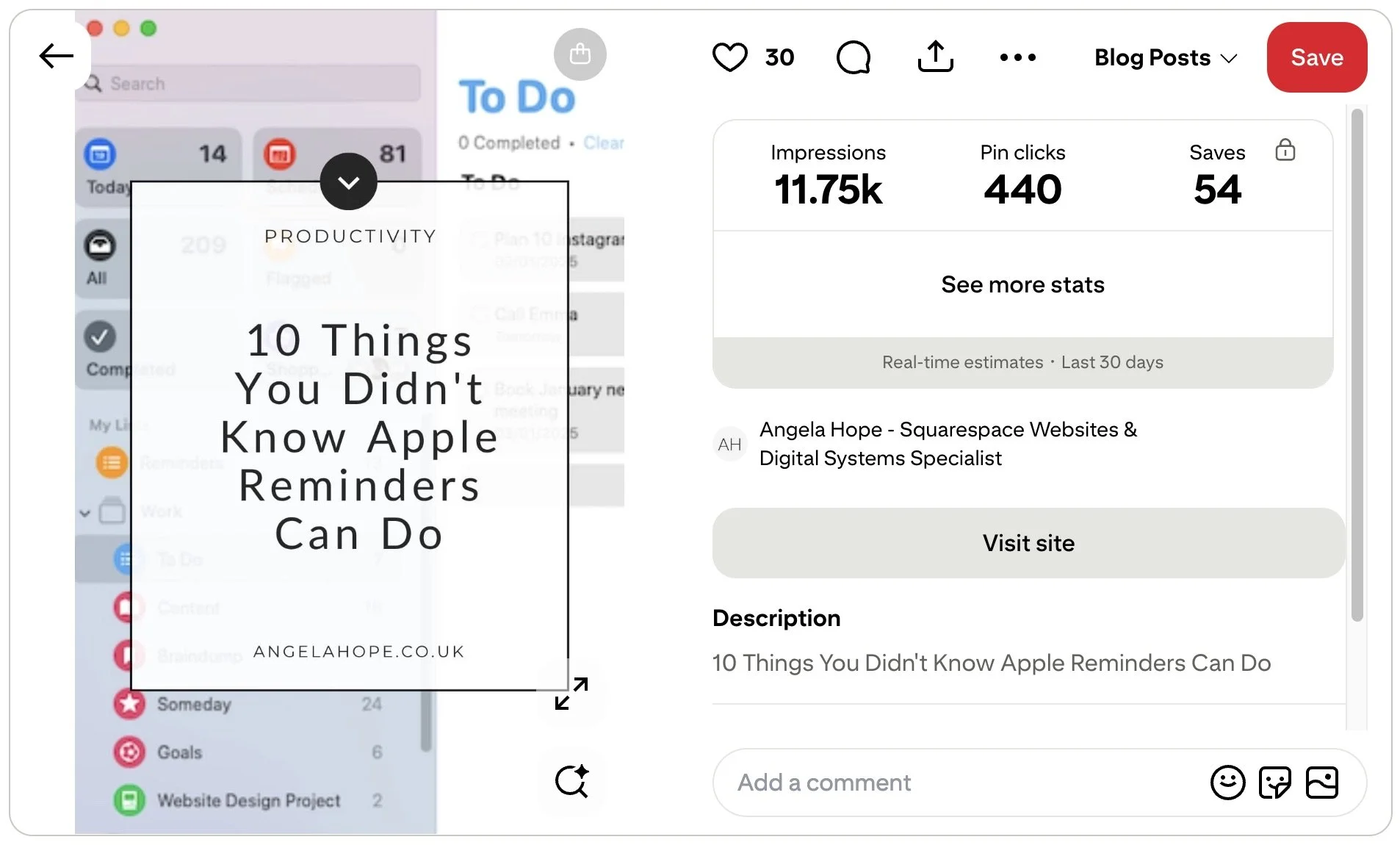
The blog post in question, 10 Things You Didn't Know Apple Reminders Can Do, has had 61,922 views to date. To put that into perspective, my next best-performing blog post has had 5,598 views. In the last 30 days alone, the Apple Reminders post has had 11,750 views, 440 clicks and has been saved to other people's Pinterest boards 54 times.
So, what happened?
What is Pinterest?
Pinterest has been around since 2010 and is often lumped in with social media platforms such as Instagram and Facebook. I think it's more useful to think of it as a visual search engine.
I primarily use Pinterest for inspiration. If I'm looking for a recipe, decorating ideas, a motivational quote, ideas for a capsule wardrobe or something similar, Pinterest is often where I'll start. I've even written about Creating a Vision Board for Your Business & Life (Without Overcomplicating It), because that's one of the ways I use Pinterest personally.
For business, Pinterest is a way of getting your content in front of people who are searching for ideas, information and inspiration. A Pin can link directly back to your website, whether that's a blog post, product, service or free resource.
This is what makes Pinterest marketing interesting. You're not simply trying to get people to notice your business; you're giving them a route from something they've discovered on Pinterest to something useful on your own website.
How did my blog post get so many views?
When I publish a blog post, I create a share image that is designed to work well on Pinterest and share it to my Pinterest account. That's pretty much the extent of my Pinterest strategy.
I don't spend hours creating Pins, researching Pinterest trends or carefully planning a daily Pinterest schedule. I simply make Pinterest part of my blog publishing process.
With the Apple Reminders post, the Pin I created was picked up and saved to someone else's Pinterest board. From there, other people found it and saved it to their own boards, which meant it was then shown to even more people.
It became a bit of a snowball effect.
The really interesting thing is that this didn't just happen once and then stop. The Pin continues to be discovered, saved and clicked on, which means the blog post continues to get traffic.
I've even had the Pin appear in the feed on both my business and personal Pinterest accounts, despite not actively looking for Apple Reminders content at the time.
That's the bit I find particularly interesting about Pinterest. Someone doesn't necessarily have to be following you or even know that your business exists. They might simply be searching for something, find your Pin and then end up on your website.
Why I think Pinterest is worth considering for your business
I don't have a particularly complicated social media strategy. I don't share individual blog posts on Instagram because I use a static nine-grid model, and I'll occasionally share posts manually on Facebook and LinkedIn. Pinterest is really the only place where I consistently share every blog post.
That's because it takes very little extra effort and gives the content another opportunity to be found.
If I write a blog post about something useful, I want people to find it. I could share it once on social media and hope that someone happens to see it at the right moment, or I can also put it on Pinterest where someone might discover it weeks, months or even years later when they're actually searching for that particular information.
It doesn't mean every Pin is going to generate thousands of views. Most of mine certainly don't. But the effort involved is so small that I think it's worth doing anyway.
For me, that's the appeal of Pinterest marketing. It's another way of distributing content that I've already created, rather than another platform where I have to constantly come up with something new.
Pinterest isn't just for blog posts
Although my own success has come from a blog post, you don't have to be a blogger to use Pinterest for business.
You could create Pins that link to your products, services, free resources or other useful pages on your website.
If you sell products, Pinterest can be a useful way of showcasing them visually. If you offer a service, you could create Pins around the problems you solve or the questions your potential customers are asking. If you've created a useful free guide or resource, that can also give people a reason to click through to your website.
The important thing is that the Pin should lead somewhere useful. The aim isn't simply to collect views on Pinterest; it's to get the right people from Pinterest onto your website.
Pinterest isn't just useful for driving traffic to your website, either. There are lots of other ways you can use it in your business. For example, I've written about using Pinterest for branding, which is a completely different way of using the platform — particularly if you're trying to develop your visual brand yourself.
Pinterest content has a long lifespan
One of the things I like most about Pinterest is that your content doesn't have the same short lifespan as a typical social media post.
Think about what happens when you post something on Instagram or Facebook. It might get some attention when you publish it, but before long it's buried underneath everything else that's been posted since.
Pinterest works differently because people are searching for content rather than simply scrolling through a chronological feed.
A Pin can continue to be discovered and saved long after you originally published it. And if other people save your Pin to their own boards, it creates more opportunities for it to be discovered again.
That's exactly what happened with my Apple Reminders post.
I didn't create it thinking it was going to become my most popular blog post. I simply created a useful article, made a Pinterest-friendly image and shared it.
The fact that it is still generating traffic more than 60,000 views later is a pretty good illustration of why I think Pinterest is worth considering.
But I don't have a Pinterest strategy...
I should probably point out at this stage that I am not a Pinterest expert.
I've read and researched Pinterest marketing and understand that there is considerably more you can do if you want to make it a serious marketing channel. You can create several different Pins for the same piece of content, experiment with different graphics and wording, research what people are searching for, optimise your boards and use Pinterest analytics to see what's working.
There are also more sophisticated strategies around regularly creating fresh Pins and distributing them across relevant boards.
That's not what I'm doing.
My Pinterest activity is deliberately simple because I'm not trying to make Pinterest my full-time marketing job. I'm simply using it as another way of getting the content I've already created in front of potential visitors to my website.
And, occasionally, something takes off.
My very simple Pinterest marketing strategy
My approach is really just part of my normal blog publishing process.
First, I create something useful, such as a blog post. Then I create a Pinterest-friendly image for it. I make my blog share images tall and vertical so they work well on Pinterest, as well as being useful for sharing elsewhere.
I then add the Pin to an appropriate Pinterest board and make sure it links back to the original article on my website.
That's it.
There are plenty of people who will be able to tell you how to develop a much more sophisticated Pinterest marketing strategy. If Pinterest is going to be a major source of leads or sales for your business, it's worth learning more about it.
But if you're already creating useful content for your website, I think there's a lot to be said for starting with something much simpler.
So, should you be using Pinterest?
If you already create content for your website, Pinterest is worth considering, particularly if your business is visual or you create content that people are likely to search for.
You don't have to suddenly develop a complicated Pinterest strategy. Start with the content you're already creating.
If you write blog posts, create a Pinterest-friendly image for each one and link it back to the post. If you sell products, create Pins that showcase them. If you offer services, think about the questions or problems your potential clients are searching for and create useful content around them.
The important thing is to give people a reason to click through to your website.
That's ultimately what happened with my Apple Reminders post. I didn't set out to create a viral blog post, and I certainly didn't have a sophisticated Pinterest strategy behind it. I just shared a useful piece of content in a place where people were looking for useful content.
And now, more than 60,000 views later, I'm rather glad I did.