How to Write Website Copy Yourself (Without Overthinking It)

If you’ve ever opened a blank document to write your website copy and immediately felt stuck, you’re not alone.
For many small business owners, writing the words feels far harder than choosing colours, fonts, or layouts. You know what you do. You help real people. You get results. But when it comes to explaining that clearly on a website, everything suddenly feels tangled.
Often it’s not a lack of skill — it’s pressure. Pressure to sound professional. Pressure to get it “right”. Pressure to say everything at once.
The good news is this: you don’t need perfect copy. You don’t need clever wording. And you definitely don’t need to have it all figured out before you start.
You just need clear copy, written with purpose.
What your website copy really needs to do
Let’s simplify this before we go any further.
Your website copy has one main job: help the right person understand that you can help them.
That means your copy should:
Make it obvious who the website is for
Explain what problem you solve, in everyday language
Reassure visitors that you understand their situation
Guide them towards a clear next step
What it doesn’t need to do is:
Explain every detail of how you work
Prove your worth to people who aren’t a good fit
Sound impressive to others in your industry
If someone leaves your website knowing what you do, who it’s for, and what to do next, your copy is doing its job.
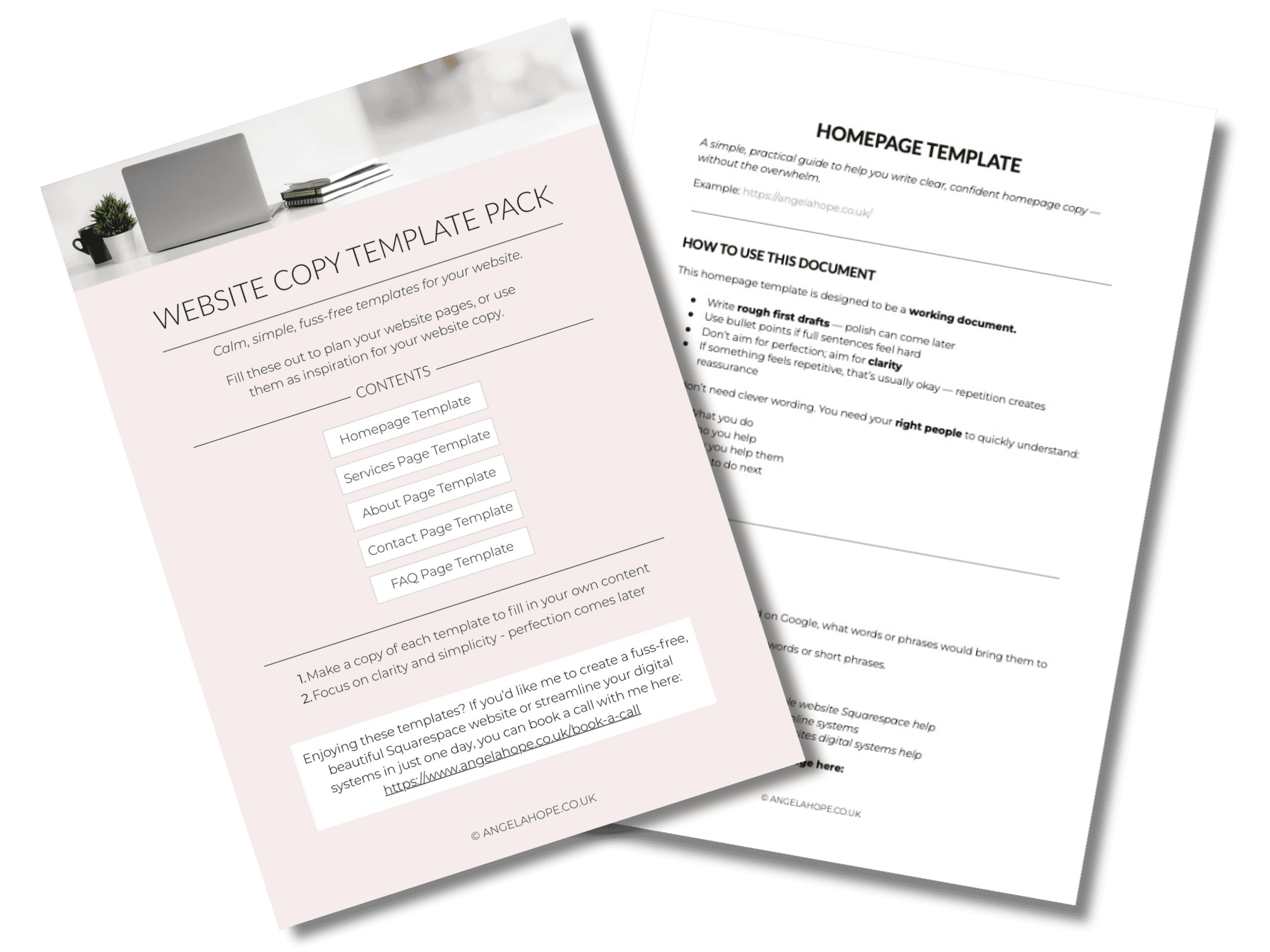
A simple framework for writing your own copy
When you’re writing copy yourself, structure matters more than wording.
Instead of trying to write beautifully, start by answering these four questions on each page:
Who is this page for?
Be specific. One person is better than everyone.What problem are they trying to solve?
Speak to the frustration or challenge they’re already aware of.How do you help — in practical terms?
Focus on outcomes and ease, not features.What should they do next?
Enquire, book, download, or get in touch.
You can write rough notes, bullet points, or imperfect sentences at this stage. That’s enough to move forward.
Home page copy: clarity before creativity
Your home page is often the hardest to write because it feels like it has to do everything.
It doesn’t.
A good home page:
Quickly confirms “I’m in the right place”
Explains what you offer in simple language
Builds confidence through tone and clarity
Points visitors towards the next step
A helpful starting point for your main headline is:
I help [who] with [what], so they can [result].
For example:
I design simple Squarespace websites and set up seamless digital systems so small business owners can save time and avoid tech overwhelm.
From there, you can expand with short sections that explain:
Your approach
Who you’re best suited to
How to work with you
Short, clear sections beat long paragraphs every time.
About page copy: build trust, not a biography
Your about page exists to answer one question: “Can I trust this person to help me?”
That trust comes from clarity and relatability, not from listing everything you’ve ever done.
Strong about pages usually include:
A short explanation of why you do this work
Who you particularly enjoy helping
How your values shape the way you work
A human touch (without oversharing)
If you’re unsure what to include, imagine you’re explaining your work to someone over a coffee. That tone is usually spot on.
Services page copy: specificity reduces uncertainty
People don’t avoid booking services because they need more adjectives — they avoid booking because they’re unsure what will happen.
Your services page should remove that uncertainty.
For each service, aim to clearly explain:
Who the service is designed for
What problem it solves
What’s included at a high level
What the process looks like
What happens next if they’re interested
Clarity here doesn’t box you in — it actually gives clients confidence.
Contact page copy: make reaching out feel easy
Your contact page shouldn’t feel like a test.
Use it to:
Set expectations around response times
Explain what happens after the form is submitted
Reassure people they don’t need to have everything figured out
A simple sentence like “If you’re not sure where to start, that’s absolutely fine — we’ll figure it out together” can make a big difference.
Common copy mistakes (and why they’re so common)
Most website copy struggles because of overthinking, not lack of ability.
Common issues include:
Trying to appeal to everyone
Using vague phrases instead of clear explanations
Writing how you think you should sound
Waiting until the copy feels finished before sharing it
Your website copy is a starting point, not a final document. It can grow and change with your business.
How this fits into my Squarespace website process
When I build Squarespace websites, I don’t expect fully polished copy on day one.
Instead, I guide clients through:
Clear copy prompts
Page-by-page structure
Copy that’s ready to design around
Once the structure is in place, the website comes together quickly — and the copy can be refined later without undoing the whole site.
This approach keeps things simple, efficient, and far less stressful.
If writing your website copy still feels hard…
That doesn’t mean you’re doing it wrong.
It usually means you’re trying to hold too much in your head at once.
Start with structure. Write imperfectly. Focus on clarity over cleverness.
A clear, live website will always beat a perfect one sitting in drafts.
If you’d like support pulling your copy and design together into a simple, streamlined Squarespace website, you can find out more about working with me → Work With Me