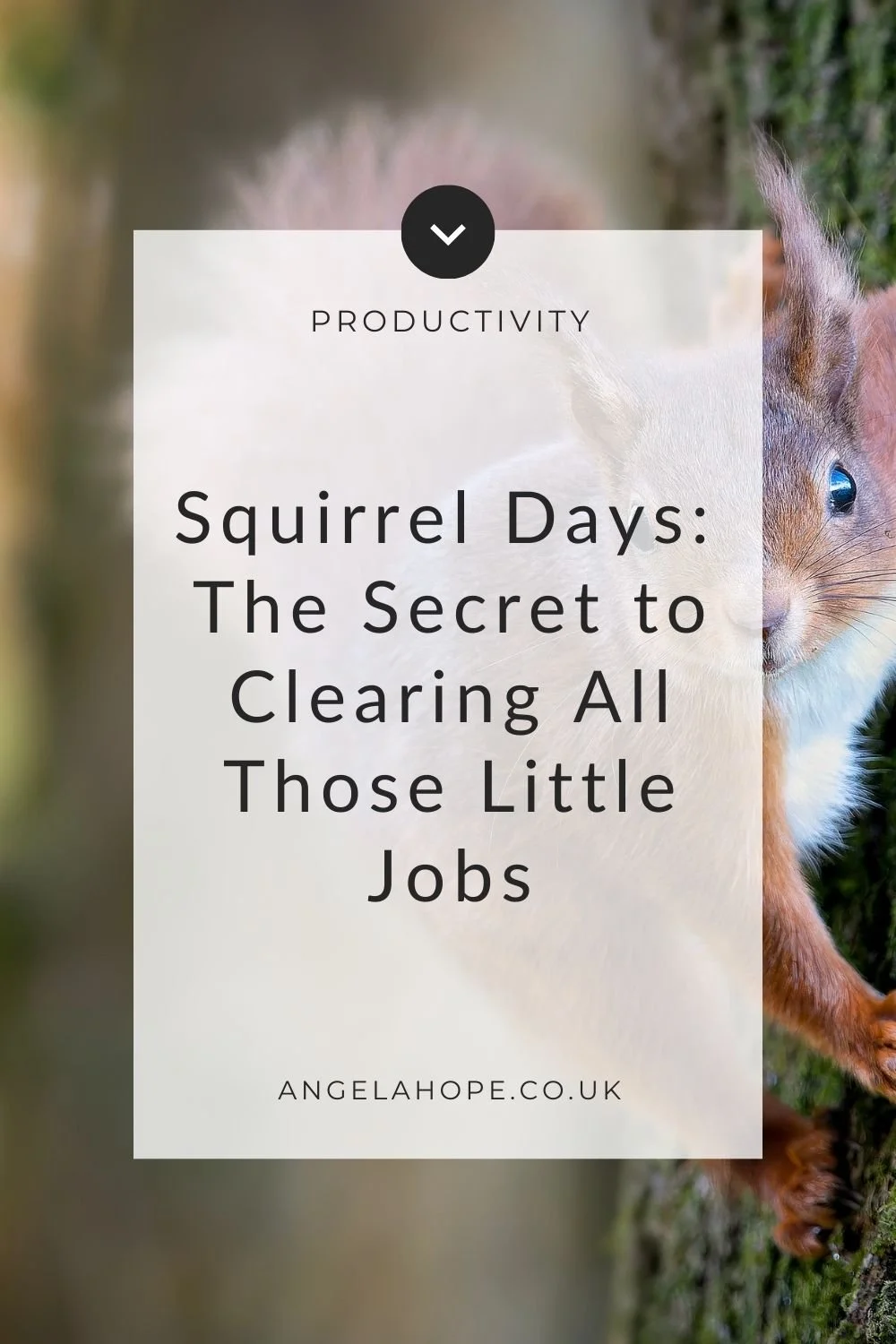
Squirrel Days: The Secret to Clearing All Those Little Jobs

Some days aren’t about big, strategic projects or deep creative work.
Some days are for being a squirrel.
A Squirrel Day is when you finally tackle all those tiny, niggly jobs that have been hanging around your to-do list for far too long. The ones that don’t take much time individually, but somehow manage to create a low-level sense of overwhelm just by existing.
You know the ones:
Update that footer text
Rename a few files
Reply to a “quick” email
Tidy up your Google Drive
Cancel a subscription
Add alt text to a couple of images
Individually, they’re small. Collectively, they’re noisy.
What Is a Squirrel Day?
A Squirrel Day is simple:
You start at the top of your list and work your way down, ticking off small tasks one by one.
If a task feels too big to “squirrel away”, you break it down into smaller, more manageable actions until it fits. No overthinking. No prioritising. No reorganising the list (that’s just procrastination in disguise).
Just:
✔️ Pick a task
✔️ Do the task
✔️ Tick it off
✔️ Move on
This is something I do often, both at work and at home. It’s a way I naturally reset when things start to feel cluttered or overwhelming.
It can feel surprisingly hard to get started, because we often equate productivity with big jobs or visible progress. Clearing small tasks can feel almost too easy to count.
But this is actually a perfect example of the snowball effect. Each tiny job ticked off builds momentum, confidence, and mental space. Before you know it, you’ve achieved far more than you expected — not through one big push, but through lots of small, intentional actions.
I recently saw someone actually name this approach a Squirrel Day — and it instantly clicked. I can’t take any credit for the term, but it perfectly describes the energy of these days.
I’ve also heard a similar approach called “tackle the tiddlers”, which is equally spot on, and always makes me smile.
Why Squirrel Days Work So Well
Squirrel Days are incredibly effective because they:
1. Reduce mental clutter
Those tiny tasks take up more headspace than we realise. Clearing them out frees up mental energy almost immediately.
2. Build momentum
Quick wins are motivating. The more you tick off, the easier it feels to keep going.
3. Remove friction from future work
Many small tasks are blockers in disguise. Once they’re gone, bigger projects suddenly feel easier.
4. Feel productive without being exhausting
Not every day needs to be intense or creative. Some days just need to be useful.
How to Plan a Squirrel Day (Without Overthinking It)
This isn’t a system-heavy process — and that’s the point.
Make a list of all the small jobs you’ve been avoiding
Don’t order them by importance — just write them down
Start at the top
If something feels too big, break it into smaller steps
Stop when your energy dips (you don’t need to finish everything)
A Squirrel Day can be:
A full day
A morning
An afternoon
Even just an hour
It’s not about perfection. It’s about progress.
When Squirrel Days Are Especially Helpful
I find Squirrel Days particularly useful when:
I’m feeling overwhelmed but can’t pinpoint why
I don’t have the headspace for deep work
I’ve been procrastinating on “easy” tasks
I want to reset before starting something new
They’re also brilliant before holidays, launches, or busy periods — anything that benefits from a cleaner slate.
Not Every Day Needs to Be a Big Day
We often put pressure on ourselves to make every working day count in a big, visible way.
But sometimes, the most valuable thing you can do is quietly clear the decks.
So if today feels scattered, low-energy, or unfocused — maybe it’s not a problem to solve.
Maybe it’s just a Squirrel Day.